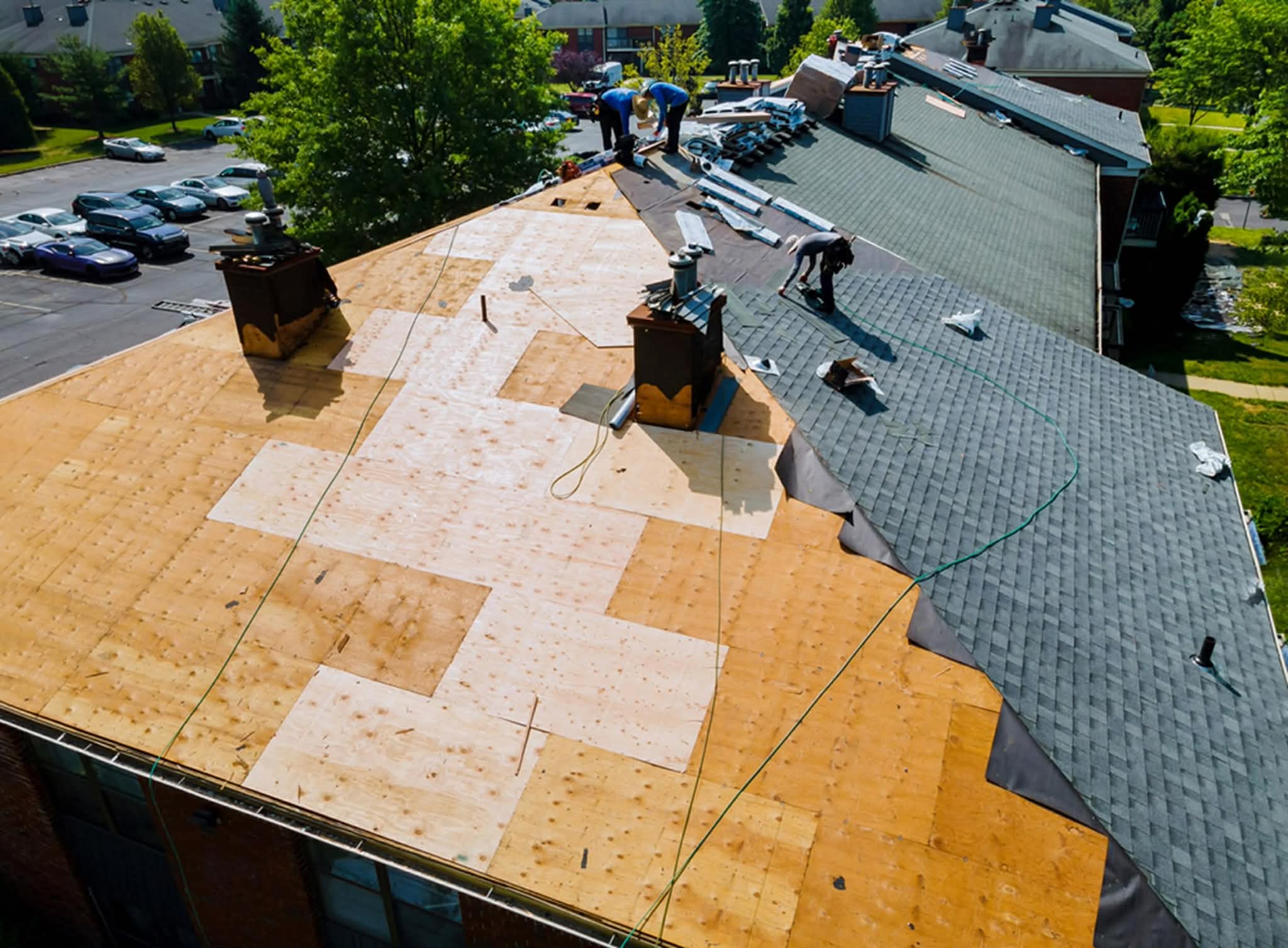
Commercial Roof Repair in New Jersey – What Every Building Owner Should Know
By Contractors Booklist • Jan 30, 2026 • 15 min
It was a humid June afternoon in Toms River, New Jersey, when I got the call from a facility manager of a 40,000-sq-ft warehouse: the flat roof was leaking into the warehouse office space. A big, old sheet‐metal deck, with a membrane roof that had seen better days. As they described it, "the rain just came right in when the thunderstorm hit." Sound familiar? If you manage a commercial building in New Jersey, you know the drill.
We climbed up, looked at pooling water near the HVAC units, found ponding, flashing failures, and some torn membrane edges. That day taught me three things:
- Commercial roofs aren't like residential homes – they have bigger spans, equipment penetrations, and LOTS of edge conditions.
- New Jersey weather plays a huge role – freeze/thaw, heavy summer storms, coastal salt air all add up.
- Waiting until the leak shows up inside is too late – the internal damage is already done.
And with that in mind, let's dig into how to approach commercial roof repair in New Jersey with real-world context, niche insight, and yes — a few imperfections (because I speak like a human, not just a polished article).
Table of Contents
- What Makes Commercial Roofs Different (And Why NJ Changes the Game)
- Common Repair Issues for Commercial Roofs in NJ
- Case Study: Mid-size Office Building in Morristown
- Choosing the Right Contractor for Commercial Roof Repair in New Jersey
- Budgeting & Cost Insight (With Real-World NJ Context)
- Proactive Maintenance & Inspection Checklist
- When to Consider Replacement Instead of Repair
- Reflections & Local Lessons Learned
- Why You Should Act Now (Rather Than "Later")
- Conclusion: Your Roof, Your Responsibility
What Makes Commercial Roofs Different (And Why NJ Changes the Game)
First off: what we mean by "commercial roof" – unlike a pitched house roof, many commercial buildings have flat or low-slope roofs, rooftop equipment (HVAC units, vents, solar panels), big penetrations, parapet walls, etc. According to the article on Membrane roofing, membrane roofs are "most commonly used in commercial application". And the definition of a roof as "the top covering of a building… providing protection against rain, snow, sunlight, and wind" applies perfectly.
Now insert the New Jersey twist:
- Coastal salt‐influenced air in towns like Atlantic City or Cape May can accelerate metal flashing corrosion.
- Freeze-thaw and heavy winters in North Jersey (think Bergen, Passaic) make ponding water much more dangerous beneath membranes.
- Summer thunderstorms and microburst hailstorms in the region (which seem more frequent lately) cause sudden damage to roofing systems — not just gradual wear.
In fact, industry data shows that the roofing contractor market in New Jersey is significant: the "Roofing Contractors in New Jersey" industry report estimates market size around $997.7 million with about 1,537 businesses. So you've got plenty of providers — but sorting the good from the "just OK" is key.
Analogy Time
Think of your commercial roof like the skin of a building. When everything's intact, it keeps out the elements; when it cracks, moisture, pests, and energy loss creep in. And in New Jersey's climate-mix, that skin takes more abuse than you might think.
Common Repair Issues for Commercial Roofs in NJ
From my years on the job I've found recurring trouble-spots — so if you're managing a property in NJ, here's what to watch for:
1. Ponding Water & Low Slope Failure
Flat roofs that don't drain properly will pool water. Over time the membrane sags or the insulation saturates, which reduces thermal value and leads to leaks. In New Jersey's heavy rainfall environment, this is particularly acute.
2. Flashing & Perimeter Failures
The edges, parapets, HVAC curbs — these are stress zones. Salt air, wind uplift, and vibration from rooftop equipment mean metal edges loosen, flashing pulls away. One repair job I saw in Paterson had flashing that literally lifted in the wind after a storm.
3. Membrane Tears, Seams, & Equipment Penetrations
Because most commercial roofs use membrane roofing systems (synthetic rubber, PVC, TPO, etc) these seams and transitions become weak spots. A quick refresher: membrane roofing "is a type of roofing system … used to create a watertight covering … most commonly used in commercial applications". You'll want a qualified contractor who understands these systems, not just someone who treats it like a house roof.
4. Energy/Wear & Age-Related Deterioration
When the roof is 15–20 years old (a typical lifespan for many commercial membranes depending on quality & maintenance) things begin to show: shrinkage, brittleness, substrate issues. One building in Newark had no scheduled maintenance for 18 years — we found the insulation saturated, the structure under strain, and cost to recover ballooned.
Case Study: Mid-size Office Building in Morristown
I'll share a quick case study because I believe concrete stories help. The building: a four-storey office complex built in 1998, built-up roof originally, in Morristown, NJ. The owner called us when ceiling tiles started falling in the 2nd floor meeting room. We found:
- Multiple splits in the built-up roof felt, ponding after storms.
- Flashings at HVAC units disconnected; the unit had shifted slightly.
- Insulation saturated and losing R-value.
Our repair plan: remove existing built-up roofing in the worst zone (about 8,000 sq-ft), install new TPO membrane (60 mil) with tapered insulation for improved drainage, replace all flashings, set up a proactive maintenance contract (bi-annual inspections). Final cost: roughly 35% less than full replacement (which the owner had feared). But here's the lesson: we could have avoided much of the damage if regular inspections had been done — saving tens of thousands of dollars.
Choosing the Right Contractor for Commercial Roof Repair in New Jersey
Here are some tips based on what I've learned — and yes, some mistakes we later corrected too.
- Check credentials and system expertise. If they specialise mostly in residential shingles, they may lack the nuances of large-scale membranes, rooftop equipment, parapets, etc.
- Ask about local climate experience. A contractor who has worked in inland NJ may not fully appreciate salt-air corrosion near the coast (and vice versa).
- Warranty and system compatibility. For instance, if you use a system by GAF Materials Corporation (based in Parsippany, NJ), which is a major North American roofing manufacturer. Using certified installers helps get robust warranties.
- Maintenance plan inclusion. No matter how good the repair, without follow-up inspections, you'll drift back into trouble.
- Site safety & access planning. Your building may house tenants — repair crews should have a solid plan for minimal disruption.
Budgeting & Cost Insight (With Real-World NJ Context)
While detailed quotes vary greatly by building size, membrane type, access difficulty, and so on — here's some context: One website says that for residential roofs in New Jersey the average cost ranges from around $5,211 to $11,174 for a typical roof. Obviously, commercial is a different scale, but the principle holds: size, material, labor all matter.
As a rule of thumb for commercial repair in NJ:
- Minor repairs (patching seams, flashing) on a moderate-sized roof might run mostly in the tens of thousands.
- Full-zone recovery (new membrane + insulation) could run hundreds of thousands for large buildings.
- Scheduled maintenance often pays for itself by extending roof life — e.g., avoiding full replacement every 15-20 years.
Proactive Maintenance & Inspection Checklist
A short checklist I hand to building managers in NJ when scopes & budgets meet reality:
- After a major storm, inspect roof drainage repair and check for any new ponding.
- Annual walk-around: check flashing, parapets, and rooftop equipment mounts.
- Every 2-3 years: full roof scan using IR/thermal imaging (to detect saturated insulation).
- Log & photograph all repairs — helps build history and justify future budgets.
- Consider coating or overlay (if system condition allows) instead of full replacement — ask your contractor about the pros/cons.
When to Consider Replacement Instead of Repair
It's tempting to keep patching forever — but there are red flags where replacement is the wiser move:
- Roof is > 20 years old, insulation is saturated, and structural deck is showing signs of rot or degradation.
- Frequent active leaks across many zones — repair costs stacking up exceed 50% of replacement cost.
- Building use changes — maybe you add solar panels, HVAC plant upgrades, and existing roof can't support additional load.
In these cases, a full replacement allows you to improve insulation (in NJ you'll appreciate lower energy bills), improve drainage, and choose newer membranes with better warranties and reflectivity (which helps with summer heat loads). A little extra upfront cost can pay dividends over 10-15 years.
Reflections & Local Lessons Learned
Here are a few personal lessons I've picked up over the years working across north, central and coastal New Jersey:
- Don't ignore the "small" roofs. I once visited a two-storey retail building in Red Bank whose roof was only ~12,000 sq-ft; because the owner treated it like a residential repair scenario, flashing was improperly done and the next winter the leak caused ceiling collapse in the café below. Size doesn't exempt you from professional attention.
- Weather shifts matter. In recent years the storms come with more hail, heavier deluges, and coastal surge. What we fixed 10 years ago is often being stretched by new weather extremes.
- Communication is key. I've found that some property-managers in NJ hesitate to schedule inspections "until the next budget cycle" — that often means the roof silently deteriorates while nobody notices. Schedule the check, budget small repairs early; it beats surprise emergency cost later.
Why You Should Act Now (Rather Than "Later")
If you're reading this and thinking "I'll wait until I see a leak," pause. Here are reasons to act proactively:
- Leaks mean downtime — in a commercial building even a half-hour water intrusion event can disrupt operations, inventory, tenant relations.
- Insurance claims get tricky. If the roof has advanced deterioration and you wait too long, insurers might contest coverage for damage under "maintenance neglect."
- Energy costs. Older, degraded membranes and saturated insulation mean your HVAC is working harder — especially in hot Central NJ summers and cold winters.
- Building value. If you plan to sell or refinance, a documented healthy roof is a huge asset. A troubled roof is often a red-flag for lenders or buyers.
Conclusion: Your Roof, Your Responsibility
In short — taking care of your commercial roof in New Jersey isn't glamorous. But it's essential. If you treat your roof like an afterthought, trust me — it will make itself noticed (usually with visible damage, leaks, and cost overruns). On the flip side: invest in good inspections, choose contractors who understand NJ conditions, plan your roof budget like you plan your HVAC budget — and you will save money, headaches, and protect the building underneath.
And yes, I started this post with a story because real-life matters. That warehouse in Toms River? After the repair we scheduled semi-annual inspections. Two years later they reported zero leaks even after a big Nor'easter. That kind of outcome is what you want.
So — if you manage a commercial building in New Jersey: don't wait for the drip to become a milestone. Inspect. Repair intelligently. Budget. Sleep easier.
Author: Contractors Booklist